The Real Story of "Anchors Aweigh" (And Why Sailors Hate Hearing It)
Walk into any dock bar, mention a boat, and inevitably, someone who has only ever set foot on a cruise ship will pipe up with, "Anchors aweigh!" They say it with a knowing nod, like they’ve just dropped some deep nautical wisdom. And if you’re a real boater, a sailor, or even just a regular at the marina, you probably felt a muscle twitch. Because while "anchors aweigh" is one of the most famous nautical phrases out there, its common usage often misses the boat entirely. Let's dig into the true anchors aweigh meaning and why it earns a collective eye-roll from anyone who actually owns a boat.
Understanding the True "Anchors Aweigh" Meaning
Contrary to popular belief, "anchors aweigh" isn't a command to hoist the anchor. It’s not a cheer for starting a journey. It’s not even an enthusiastic declaration that you’re about to cast off. Instead, the true anchors aweigh meaning describes a specific state: when the anchor has been successfully lifted clear of the seabed and is hanging freely from the hawsepipe.
Think of it as a status report, not an action verb. The anchor is "aweigh" — literally "off the ground" or "in the air." It's the moment the boat is no longer moored by its anchor and is free to move, whether under power or sail. It's a critical point in the operation, signifying that the boat is now mobile, but it's not the command to *begin* pulling it up. That command would be something like "Heave anchor!" or "Anchor up!"
A Brief History of the Phrase
The phrase "aweigh" itself comes from Old English, meaning "up" or "off the ground." Its application to anchors has been part of nautical lexicon for centuries. It gained significant popular recognition, particularly in the United States, with the 1906 composition of "Anchors Aweigh," the official march of the U.S. Navy. Written by Lieutenant Charles A. Zimmermann, it was originally intended for the Naval Academy's graduating class.
The song's widespread popularity cemented the phrase in the public consciousness, often divorcing it from its precise nautical definition. For the Navy, it became a rousing anthem of departure and readiness. For the average landlubber, it simply became a catch-all for "let's go boating!" — a common boating myth that persists to this day.
Why Real Sailors Cringe When They Hear It
For those who spend their weekends wrestling with a windlass or untangling a snubber, hearing "Anchors Aweigh!" shouted with cheerful ignorance is like a chef being told to "microwave the soup!" It's not just a minor inaccuracy; it reveals a fundamental misunderstanding of the process and the terminology that comes with actual boat ownership. It’s the difference between someone who watches a fishing show and someone who actually cleans a fish.
It’s the quiet satisfaction of knowing the difference, of being in on the joke that owning a boat is a financial decision shaped like a boat, but also a source of real pride and knowledge. This isn't gatekeeping; it's just acknowledging that there's a craft to it. You wouldn't tell a carpenter to "hit the wood with the hammer thingy," would you? So why butcher the language of the sea?
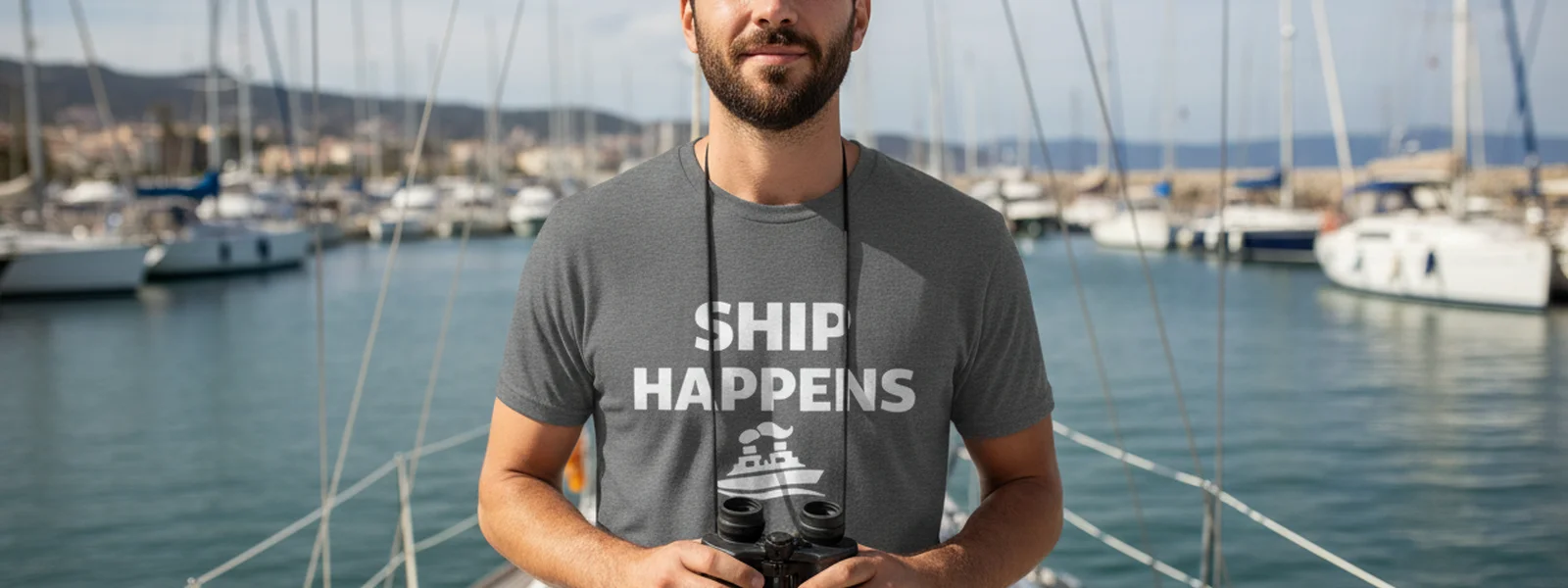
For those who know the real score, our Ship Happens Nautical Humor T-Shirt for Boat Owners is a quiet nod to the shared experience. It’s for the boater who understands the actual anchors aweigh meaning and just rolls with the rest of it.
Common Boating Myths & Misconceptions Beyond the Anchor
The "anchors aweigh" confusion is just one of many ways popular culture misrepresents life on the water. Here are a few other common boating myths that get under a real boater's skin:
- "Knot" as a verb: "Knotting a rope" is what you do to your shoelaces. On a boat, you "tie" a knot. There's a big difference in precision.
- "Port" and "Starboard" are interchangeable with "left" and "right": While technically correct in context, real sailors use port and starboard because they are absolute — they never change, regardless of which way you're facing.
- "Throw me a rope!": It's a "line," not a rope, once it's cut and put to use on a boat. Ropes are what you buy at the store.
- "Sail away to paradise!": This one belongs squarely in the cruise line brochures. Real sailing is often about the work, the weather, and the quiet satisfaction of making it to the next port, not just the destination.
These little linguistic quirks are part of the specific sailing terminology that distinguishes a seasoned boater from a casual observer. It’s the language of the dock, the marina, and the open water.
Wearing Your Boating Cred (and Your Humor)
At Ship Happens Shirt, we get it. We know the difference between a sheet and a halyard, and we know that "anchors aweigh" is a state, not a command. That's why our designs are made for people who actually own, slip, captain, crew, or hang out at boats. We're not selling to cruise ship vacationers; we're selling to the Slip-Renter Steves and Sailing-Club Sams of the world. Our apparel is designed at the dock, printed on the good blanks, and built to withstand a season of real laughs and real boat life.
Whether you're looking for a dry-humor tee about your latest dock-side mishap or a shirt that quietly signals your nautical expertise, check out our Boat Humor T-Shirts. They’re worn at the marina, the brewery, and the lawn-mowing weekend, not the buffet.
Our Ship Happens Boat Humor T-Shirt is a prime example — simple, direct, and speaks volumes to those who know.
More Than Just a Shirt
It's about being part of the community that understands the nuances, the frustrations, and the absolute joy of being on the water. It's about the self-aware humor that comes from knowing you signed up for a boat, and all the "ship happens" moments that come with it. Our shirts are for the boater who appreciates genuine sailing terminology and can spot a landlubber's cliché from a mile away.
Explore the full range in our Boat Owner Shirts collection, crafted for those who actually own, maintain, and love their boats — not just talk about them.
And for the real leaders on deck, our Captain & First Mate Shirts acknowledge who's truly in charge (and who just thinks they are).
Conclusion: Know Your Nautical Terms
So, the next time you hear someone exclaim "Anchors Aweigh!" as if it's a command, you'll know the real anchors aweigh meaning. You'll understand that it's a statement of status, not an order. And you'll probably just offer a polite, weathered smile. Because for real boat owners, the humor is in knowing the difference, and sometimes, letting others learn the hard way.
Want to dive deeper into actual boating lingo? Read our article on Sailing Knot Tutorial Without the Boring Part or check out The Top 10 Funny Things Sailors Yell at Each Other for more authentic dock-side humor. Because real boats mean real laughs, and sometimes, those laughs are at the expense of a misused phrase.
Ready to wear your humor with pride? Shop the Lineup and find a shirt that truly speaks to your boating life.

Published by Ship Happens Shirt
Real boats. Real laughs.
Frequently Asked Questions
What is the actual meaning of 'Anchors Aweigh'?
The phrase 'anchors aweigh' describes the moment an anchor is lifted clear of the seabed and is hanging freely from the vessel. It signifies that the boat is no longer moored by its anchor and is free to move, but it is not a command to begin raising the anchor.
Why do experienced sailors dislike the common use of 'Anchors Aweigh'?
Experienced sailors often cringe because the phrase is frequently misused in popular culture as a command to start a journey. For them, it's a specific technical status, not a general cheer, and its misuse highlights a lack of understanding of nautical terminology.
What is the origin of the phrase 'Anchors Aweigh'?
The term 'aweigh' comes from Old English, meaning 'up' or 'off the ground.' Its association with anchors has been used in nautical contexts for centuries. The phrase gained significant popular recognition through the 1906 U.S. Navy march of the same name.
What's the difference between 'Anchors Aweigh' and a command to raise the anchor?
'Anchors aweigh' is a descriptive status indicating the anchor is clear of the bottom. A command to raise the anchor would be an action-oriented phrase like 'Heave anchor!' or 'Anchor up!'. The former is a report; the latter is an instruction.
Are there other common nautical phrases that are often misused?
Yes, many. Examples include calling all ropes 'ropes' instead of 'lines,' using 'knot' as a verb for tying, or using 'left' and 'right' instead of 'port' and 'starboard' in a nautical context. These small inaccuracies often reveal a lack of real boating experience.
Why is correct nautical terminology important for boat owners?
Accurate nautical terminology is crucial for clear communication, especially in safety-critical situations. It also reflects a respect for the maritime tradition and the specific skills involved in operating a vessel. It's part of being a knowledgeable and competent boater.
Tied off and standing by
New designs, dock-life dispatches, and the occasional sale. No spam.